
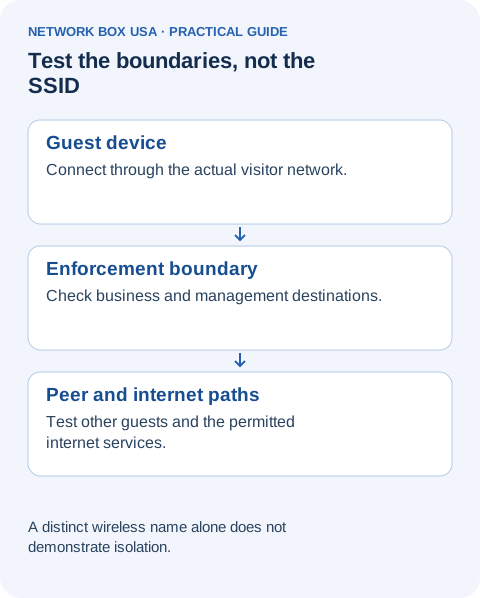
A guest Wi-Fi network should give visitors the access you intend while keeping business systems outside their reach. A separate Wi-Fi name does not establish that boundary on its own. The design also needs a separate traffic path or network segment, rules governing access beyond it, and a decision about whether guests may communicate with one another.
For an IT director, MSP, or property operator, the useful question is specific: what can a device reach after it joins the guest network? Answer that for business systems, network administration, other guests, and any approved shared resource.
A network name identifies a connection; policy controls its reach
The SSID is the Wi-Fi network name a visitor selects. It helps users choose the intended connection, but the name alone says nothing about where the access point forwards their traffic. A guest network can be given a different name while still connecting devices to an internal network.
NIST SP 800-153 recommends separating wireless networks with different security profiles, including guest and internal use. Where visitors need internal access, it recommends limiting that access to the necessary hosts or subnets and protocols.
Ask the network operator to show the guest traffic path from the access point to its gateway. A dedicated VLAN is one way to separate traffic on shared infrastructure, but the design must also control communication between that segment and other networks. A diagram should identify the enforcement point, not merely display two differently named boxes.
NIST's firewall guidance explains the role of policy in permitting required traffic and blocking traffic that is not expressly permitted. Applied here, the permission should describe which guest connections are necessary, rather than broadly allowing access to every internal destination.
Guest-to-business and guest-to-guest access are different decisions
Preventing visitors from reaching business systems does not establish whether two visitors can reach each other. Wireless client isolation addresses communication between wireless clients. Its actual scope depends on the equipment and configuration, so the operator should verify the behavior across the access points and network paths in use.
Original research by Timur Mirzoev and Stacey White examined client isolation against a specific wireless attack. The study illustrates the distinction between restricting communication among associated wireless devices and protecting the connected wired network. Its older, product-specific experiment is not a guarantee about a modern deployment.
Define these outcomes separately in the acceptance criteria. Visitors might need internet access while being unable to reach staff computers, payment systems, infrastructure administration, or other visitors. Each is a distinct access question. Avoid accepting an ambiguous statement such as “guest isolation is enabled” as evidence for all of them.
A meeting-room display makes the tradeoff concrete
Consider a hypothetical office that lets visitors present to a meeting-room display. The original guest design allowed internet access only. When presentation sharing fails, opening the whole staff network would change the boundary far beyond the actual business need.
Instead, have the application and network owners establish exactly how the display is discovered and used. Evaluate a controlled presentation service or narrowly defined access to the approved resource. The required design depends on the display and protocol; this is a decision example, not a universal configuration recipe.
Record the resource, permitted users, required communication, and responsible owner. If that arrangement cannot preserve the intended separation, use another presentation method. Convenience can justify a specific exception, but it should not silently redefine what every visitor may reach.
A guest-isolation acceptance matrix
Run authorized checks from an actual guest device. Record both address families and the controls enforcing each result.
| Path | Expected result to agree | Evidence |
|---|---|---|
| Guest → business subnet | Deny unless a specific service is intentionally exposed. | Destination, protocol, address family, result, and control. |
| Guest → management interface | Deny administrative access. | Actual interface tested, result, and exception owner. |
| Guest → other guest | Allow or deny according to the guest-use policy. | Test clients on the same and different access points where relevant. |
| Guest → approved internet use | Permit the intended service. | A complete user transaction and applicable browsing-policy result. |
Apply the checks to hospitality properties, retail stores, or campus networks.
Accept observed behavior and assign ownership
Use an agreed, authorized test to demonstrate the intended connections and restrictions. NIST SP 800-115 provides guidance for planning security tests and evaluating their results. For this purpose, the network team can use controlled devices and harmless connection attempts to designated test destinations.
Our recommendation is to record the guest connection used, destination, expected result, observed result, and relevant enforcement evidence. Include representative access points and supported address families. A failed connection alone is ambiguous: the target could simply be unavailable. Have the operator establish why access was denied, and distinguish verified restrictions from untested paths.
Network Box USA's Managed Unified Threat Management combines firewall, intrusion prevention, traffic policy, logging, and operational support. Agree who owns wireless settings, switching, routing, guest exceptions, and validation alongside the subscribed gateway controls. To discuss how those responsibilities fit your environment, contact our team.