
Web apps, APIs, Rules, Signatures, Tuning, Logs.
Services · Prevent
Managed Web Application Firewall Services
Protect public web apps before traffic reaches your code.
WAF protection helps block malicious requests, common exploit patterns, and unwanted application exposure for internet-facing services.
Based in Houston. Serving organizations and MSPs across North America.
What changes
The control matters. The ownership around it matters more.
Request filtering, Attack signatures, Application policy, Tuning, Reporting.
Block malicious requests, Reduce exposure, Support audits, Protect customer trust.
Service definition
What Web Application Firewall does.
A managed Web Application Firewall protects internet-facing applications and APIs by inspecting requests, enforcing application-layer policy, blocking common exploit patterns, and tuning controls as applications and threats change.
- Organizations operating customer portals, ecommerce systems, APIs, or public applications
- Teams that need ongoing WAF rule tuning and security reporting
- Businesses reducing exposure to OWASP risks without staffing a dedicated application-security operation
- SQL injection, cross-site scripting, malicious requests, bots, and application-layer abuse
- Generic rules that create noise or interfere with legitimate application traffic
- Public applications changing faster than their protections are reviewed
- Limited evidence for application-security reviews and investigations
Product details
Evaluate the capabilities that matter in your environment.
The service protects web applications from OWASP Top 10 risks, malicious requests, and application-layer attacks.
Rules, monitoring, response filtering, load balancing, and threat isolation are managed together.
Unlimited domains and rules are presented as part of the predictable service-pricing model.
Architecture diagram
See protection before the origin.
Follow HTTPS requests through WAF+ to protected applications, with malicious traffic blocked and direct origin access restricted.
Explore the full diagram, or download its single-page PDF for review and printing.
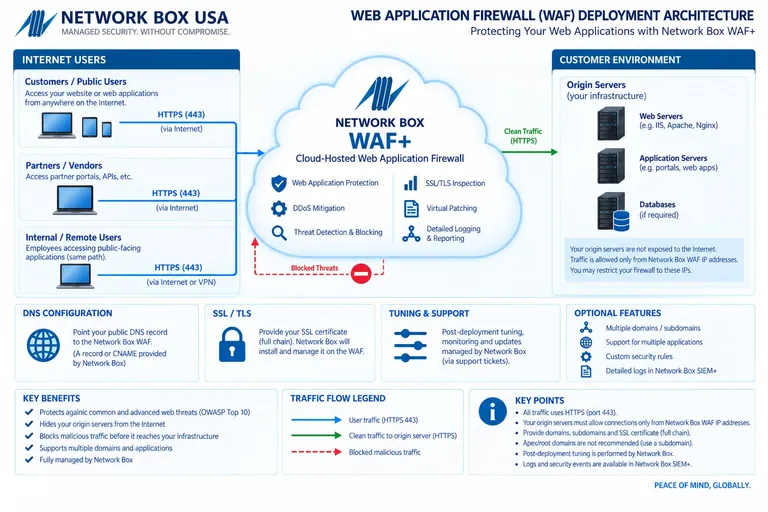
Web Application Firewall
HTTPS application protection and restricted origin access.
Managed from day one
One continuous operating motion.
Deployment is the beginning of the service, not the end of the project.
- 01Assess the environment
Review the sites, users, systems, traffic flows, obligations, current controls, and operating constraints that shape the service.
- 02Design the coverage
Define in-scope assets, policies, integrations, retention, escalation paths, responsibilities, and success measures before deployment.
- 03Deploy and tune
Connect or install the service, validate traffic and telemetry, test policy behavior, resolve exceptions, and document the operational handoff.
- 04Monitor and respond
Operate, update, tune, review, and escalate the subscribed controls according to the agreed monitoring and support scope.
- 05Report and improve
Review activity, evidence, exceptions, service trends, and recommended next priorities with ownership made clear.
Choose the right layer
How this service differs from adjacent coverage.
These services work together, but they solve different operational problems.
Compared with Unified Threat Management
UTM+ protects network traffic and the broader perimeter. WAF applies application-aware controls to HTTP and HTTPS requests reaching specific public applications and APIs.
Compared with Secure Web Gateway
SWG protects users browsing outward to the web. WAF protects public applications from traffic coming inward from internet users and automated clients.
Related coverage
Security works better when the layers work together.
Included with Web Application Firewall
The service, clearly accounted for.
Review the protection, operating support, and service capabilities included in the offering.
21included
capabilities
capabilities
01
Application protection
- Protection for the OWASP Top 10 web-application risks
- Stateful firewall, NAT, and advanced routing
- Frontline, inline, and infected-LAN intrusion prevention
- SSL traffic protection and inspection
- Dynamic IP blocking with a managed penalty box
- Certificate-policy validation and enforcement
- DDoS protection across Layers 3–7
- Bidirectional IPv4 and IPv6 translation
02
Application control
- Granular policies by user, path, and URL
- High-volume customizable rule processing
- Internal and external load balancing
- Response filtering and data-exfiltration protection
- Client authentication
- Customizable log portal and reporting
03
Managed-service layer
- 24×7×365 monitoring and PUSH security updates
- 24×7 Security Operations Center
- SIEM with 90 days of rolling log access
- Security Response Center threat research
- Four ISO certifications and PCI DSS attestation
- Intelligence from more than 70 threat partners
- Standard service-level agreement
Buyer’s guide
Commercial scope and compliance context.
Evaluate the complete operating commitment, not only a license or feature list.
A defined managed scope
Pricing is scoped around protected applications and domains, traffic volume, availability requirements, certificate and deployment needs, rule complexity, logging, and managed tuning. The proposal should identify included applications, operations, reporting, and any optional engineering work.
Compare the full operating cost →Technical support, not a compliance guarantee
No single product establishes compliance. These guides show where the service can support controls, operations, and evidence.
Application security assessment
Web Application Firewall scorecard
How well are your public web applications protected?
Self-guided review7 questions
Answer seven questions about application coverage, blocking, tuning, origin exposure, and monitoring.
0/100
Your point-in-time result
Review in progress
Service FAQ
Questions buyers ask about Web Application Firewall.
What is Web Application Firewall?
A managed Web Application Firewall protects internet-facing applications and APIs by inspecting requests, enforcing application-layer policy, blocking common exploit patterns, and tuning controls as applications and threats change.
Who is Web Application Firewall designed for?
Common fits include organizations operating customer portals, ecommerce systems, APIs, or public applications, teams that need ongoing WAF rule tuning and security reporting, and businesses reducing exposure to OWASP risks without staffing a dedicated application-security operation.
What does Network Box USA manage?
The managed scope includes request filtering, attack signatures, application policy, tuning, and reporting. Exact responsibilities, coverage, escalation, and exclusions are confirmed during solution design.
How does Web Application Firewall differ from Unified Threat Management?
UTM+ protects network traffic and the broader perimeter. WAF applies application-aware controls to HTTP and HTTPS requests reaching specific public applications and APIs.
How is Web Application Firewall priced?
Pricing is scoped around protected applications and domains, traffic volume, availability requirements, certificate and deployment needs, rule complexity, logging, and managed tuning. The proposal should identify included applications, operations, reporting, and any optional engineering work.
Does Web Application Firewall make an organization compliant?
No single security service establishes compliance. Web Application Firewall can support technical controls and evidence associated with PCI DSS, NIST CSF, CIS Controls v8.1, SOC 2, HIPAA, and CMMC, but applicability, governance, policies, complete scope, remediation, and any assessment or certification remain the organization’s responsibility.
Security stack review
See where Web Application Firewall belongs in your environment.
Start with your current controls, operating constraints, and the risks you most need to reduce.
Request a Security Stack Review